LLMjacking: Your API Key Is a Credit Card Now
Twenty years of managing who gets access to what taught me that the dangerous account is never the one everyone’s watching. It’s the one nobody thought to watch at all.
A Six-Figure Bill With No Login Screen
For 25 years, “protect your credentials” meant your password, your badge, your SSN. The cost of leaking one usually showed up weeks later, as a breach notice. This month’s reporting on stolen AI API keys breaks that model, and it’s worth getting the actual story right before drawing lessons from it — because the real numbers are more alarming than the version that’s circulating.
The source isn’t a vague “security roundup.” It’s Google’s Threat Intelligence Group (GTIG), working with Mandiant, who spent 2026 responding to real incidents across financial services, retail, technology, and transportation on three continents. Their finding: criminals are breaking into cloud accounts, running AI models at the victim’s expense, and reselling that access through what GTIG calls “LLM mixers” — criminal routing services that pool stolen AI access from multiple break-ins and resell subscriptions to it. One mixer, nicknamed Jet Night, sold an unlimited-usage plan for about $60 a month — a quarter of what a legitimate subscription costs. GTIG’s conclusion was blunt: that price only works with stolen keys paying the real bill.
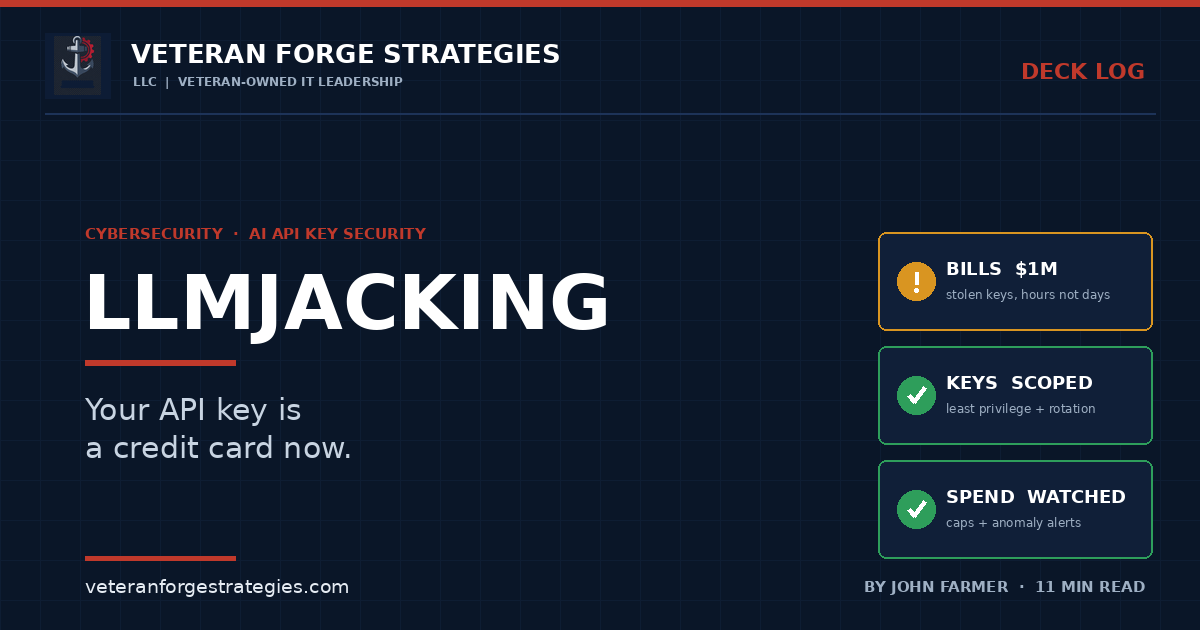
And “$100,000 a day” is the floor, not the headline number. That’s what some attacks produced in a single day before anyone noticed. In the worst documented cases, cumulative charges reached $1 million before the victim managed to revoke access. One resale customer made more than 500,000 API calls in under eight hours, running up close to that million-dollar figure on token fees alone. A leaked password gets noticed at a login screen. A leaked API key gets noticed on an invoice, and by then the damage is already billed.
Scale that against what a typical small business actually spends on AI tools — often a few hundred dollars a month across a handful of subscriptions — and the asymmetry is the whole problem. You don’t need to be a Fortune 500 cloud customer to be worth hitting. You just need a key that works and nobody watching it. A criminal running a mixer subscription doesn’t care whose account is paying the bill; they care that the meter is running and the alarm isn’t.
Why an API Key Doesn’t Behave Like a Password
A password is built to be typed by a human, at a login screen, where a failed attempt or an unfamiliar location can trip an alert. An API key is built to be used by machines, at machine speed, billed by the token, with no login screen at all. Steal one and you don’t trigger a failed-password counter — you just quietly spend someone else’s money, around the clock, until the invoice lands.
GTIG’s incident writeups describe attackers testing stolen keys with deliberately tiny requests — a single token’s worth of output, essentially a blank API call — specifically to confirm a key still works without generating the kind of spend spike that might trip a billing alert, if the victim even has one. It’s reconnaissance at a scale and patience level that doesn’t map to how most IT teams think about credential monitoring. We’ve spent two decades hardening the login page. Almost nobody has built the equivalent discipline around API spend.
Where the Keys Actually Leak
None of the entry points GTIG catalogued are exotic. Stolen cloud credentials — service account keys, GitHub personal access tokens, active session tokens — were the most common way in. A close second: keys harvested straight out of public GitHub repositories, where a developer committed a config file or a notebook with a live key still in it. Attackers also scan for exposed model endpoints directly, and in one documented case, a fake login portal tricked a user into pasting in data containing an active access token — sidestepping the password and the MFA prompt entirely, because the token itself was the only thing that mattered.
The case that should worry anyone running an AI gateway in front of their models: a vulnerability tracked as CVE-2026-40217 in the LiteLLM gateway software let one attacker turn an ordinary, properly-scoped API key into a fully privileged administrator credential. That’s the gateway-exploitation risk most teams haven’t priced in yet — the control plane sitting in front of your AI access can itself become the weak link, independent of whether any individual key was ever mishandled.
Notice what those entry points have in common: none of them require breaking encryption, guessing a password, or defeating MFA. They require finding a credential someone already created and then forgot was sensitive. That’s a people-and-process gap, not a cryptography gap — which is good news, because the fix doesn’t require new technology either. It requires treating the key with the same seriousness you’d treat a physical master key to the building.
Treat Keys as Crown-Jewel Credentials
The fix starts with the same discipline that should already govern every other privileged credential in the organization — the same lifecycle thinking that applies to any account with access worth protecting. A key that can do everything, forever, with no expiration and no scope limit, is a liability the moment it’s issued, not just the moment it’s stolen.
- Scope every key tightly — to the specific model, the specific workload, the specific environment. A key minted for one internal tool should not also be able to touch production billing.
- Rotate keys on a real schedule, not “whenever someone remembers.” A key that’s been sitting unchanged for a year is a key nobody’s actually checked on for a year.
- Keep them in a secrets manager or vault — never in a Git repo, a config file committed to source control, a shared doc, or a Slack message. If it’s typed in plaintext anywhere a second person can read it later, assume it eventually leaks.
- Kill keys the day a project, vendor relationship, or employee ends — the same offboarding discipline that should already apply to every other credential.
The Control Nobody Has: Watching the Spend
Here’s the control that’s actually missing almost everywhere, and it’s the one that would have caught every incident in GTIG’s report faster: treating API spend like a monitored system, not a monthly surprise. We’ve already made the case that quiet systems are watched systems — the same principle that applies to disk space and uptime applies to a cloud bill that can move six figures in a day.
Concretely, that means hard spend caps set per key or per project, not just a company-wide budget alert that fires after the damage is done; anomaly alerting that flags a sudden jump in call volume the way you’d flag a login from an unfamiliar country; and a monthly habit of actually reading the line items on the AI/cloud bill, not just glancing at the total. GTIG’s report also noted several incidents where attackers quietly re-enabled an AI service the victim had disabled, using the still-valid stolen key — which means “we turned it off” isn’t the same as “we revoked the credential.” Those are two different actions, and only one of them actually closes the door.
Here’s what that looks like for a small or mid-size business, not a hyperscaler. If you’ve got three or four people using an AI API across a handful of internal tools, the whole monitoring setup can be one dashboard and one alert rule: a daily spend threshold per key that’s maybe 20% above your normal usage, an email or Slack alert the moment it trips, and a standing habit — same day every week — of someone actually opening the billing page and reading it instead of trusting the automated summary. That’s a half-day of setup, not a new hire. The businesses that get hit with a surprise five-figure bill are almost never the ones who built that half-day of monitoring; they’re the ones who assumed the provider would flag it for them. Providers do flag unusual activity sometimes — but by the time their systems act, you’ve already seen what GTIG’s report describes: hours, not minutes, of unmetered use.
This Isn’t a Separate Risk From the Rest of Your AI Exposure
Stolen API keys don’t exist in isolation from the rest of how AI tools entered your organization. The same unmanaged sprawl that creates shadow IT and ungoverned SaaS is exactly how a key ends up in a personal GitHub repo, a browser extension, or a side project nobody in IT signed off on in the first place. And once a stolen key is being used to generate convincing AI output on someone else’s dime, you’re one step from the verification problem we’ve already written about — the fact that AI-generated voice, video, and text are cheap enough now that “it sounded right” has stopped being evidence of anything.
The practical takeaway: an AI-key incident response plan that only covers “revoke the key” is incomplete. It needs to also ask what else that access could have touched, and whether the same gap that let the key leak is letting other things leak too.
The Federal Angle: Secrets Management Isn’t Optional Under CMMC
For anyone handling Controlled Unclassified Information, this stops being a best practice and becomes a contractual obligation. NIST SP 800-171’s System and Communications Protection family (3.13 in Rev 2, renumbered 03.13 under Rev 3) includes control 3.13.10 — “Establish and manage cryptographic keys” — which maps directly to CMMC Level 2 practice SC.L2-3.13.10. An API key used to reach a model that touches CUI is functionally the same category of thing that control is written to govern. Pair that with the Access Control family’s least-privilege requirements, and the compliance case for scoped, rotated, vaulted keys is already written into the framework most federal contractors are being assessed against. This isn’t a new obligation the AI era invented — it’s an old obligation most organizations hadn’t yet applied to a brand-new kind of credential. The Access Control family (3.1, renumbered 03.01 under Rev 3) is the broader umbrella: least privilege, authorized access enforcement, and separation of duties were written for exactly this kind of scoping decision, years before anyone was issuing credentials to a language model. An assessor asking “who can use this AI integration, and what can it reach” is asking a question your existing access-control documentation should already be able to answer — if it’s been updated to actually include AI credentials as a category, which is the part most System Security Plans still haven’t caught up on.
Where This Usually Goes Wrong
- Treating an API key like a config setting instead of a privileged credential, because it doesn’t look like a password.
- Assuming MFA covers you — it doesn’t, if the thing that’s stolen is a working token that bypasses the login screen entirely.
- Setting a company-wide budget alert and calling that “monitoring,” when the incident that actually hurts is one key spiking in isolation.
- Disabling a compromised AI service and assuming that’s the same as revoking the credential that compromised it.
- Discovering the leaked key the same way GTIG’s victims did — on the invoice.
Twenty-five years in, the pattern never really changes: the systems that cause real damage are rarely the ones everyone’s watching. They’re the ones nobody thought needed watching yet. Six months ago, almost nobody would have listed “API key” next to “credit card number” on the list of things worth guarding that closely. This year’s invoices are making the case for them.
Veteran Forge Strategies is an SBA-Certified Service-Disabled Veteran-Owned Small Business providing IT infrastructure, operations, and cybersecurity support to small businesses and federal clients from Northern Virginia. If your organization adopted AI tools this year and nobody’s watching what those credentials can actually do, that’s exactly the kind of gap worth closing before the invoice tells you about it — get in touch. You can also read about how a fractional IT engagement works, or browse the rest of the Deck Log.