The Human Firewall: Why Security Awareness Training Usually Fails
You can spend a fortune on security tools and still get beaten by a single click. After twenty-five years of watching how breaches actually start, I’ve come to believe the cheapest, highest-return control most organizations own is also the one they treat worst: their own people.
Here is an uncomfortable truth that every honest IT leader eventually accepts. You can buy every security product on the market — the firewall, the endpoint protection, the email filtering, the fancy dashboard — and still get breached by one person clicking one link. The attacker rarely beats the technology head-on. They walk through the front door, because someone clicked, replied, or approved something they shouldn’t have. Year after year, industry breach reporting like the Verizon DBIR finds the human element involved in the large majority of incidents. Your people are your last line of defense whether you have trained them for it or not.
So most organizations do “security awareness training.” And most of it is worthless. Not because the idea is wrong — because the way we deliver it is almost perfectly designed to fail.
Why the usual training fails
Picture the standard program. Once a year, every employee is assigned a forty-minute slide deck with a quiz at the end. They open it in one browser tab, mute it, work in another tab, and click “next” until the certificate prints. Compliance box checked. Nobody learned anything, and everybody resents the hour. A threat landscape that reinvents itself every few months is being answered with a lecture delivered once every twelve.
Then there is the phishing simulation done badly. The company sends fake phishing emails, and anyone who clicks gets publicly flagged, enrolled in remedial training, or worse. The intent is to measure risk. The actual result is that you have taught your staff that security is a trap set by their own IT department, and that getting caught is punished. So what happens the day someone genuinely clicks something suspicious? They say nothing. They hope it was fine. They sit on it for a day and a half because admitting it feels dangerous — and that day and a half is exactly the window an attacker needs.
Fear and blame don’t produce vigilance. They produce silence. And silence is the most expensive outcome in all of security.
What actually works
The programs I have seen change behavior share a few traits, and none of them involve a longer annual deck.
Short and regular beats long and annual. A two-minute explanation of one real tactic, delivered when it is relevant, sticks far better than a forty-minute omnibus once a year. People retain a steady drip; they forget a flood. Tie it to what is actually circulating — a gift-card scam in December, a fake invoice during budget season, a “your package is held” text everyone is getting this week.
Real examples beat abstractions. Don’t lecture people about “social engineering.” Show them the actual email that hit the accounting team last month, with the tells circled — the display name that doesn’t match the address, the false urgency, the link that goes somewhere other than where it claims. People remember a story they recognize. They forget a definition.
Phishing simulations, done right, are a teaching tool — not a trap. Run them, but use them to coach, not to punish. When someone clicks, the moment is a short, private, blame-free “here’s what to look for next time,” not a public mark on their record. The goal is a workforce that gets better, not a leaderboard of the shamed.
This is the same principle that makes shadow IT manageable rather than adversarial: when people aren’t afraid of the IT department, they tell you what’s actually happening, and that visibility is worth more than any policy you can enforce from the outside.
The real goal: one habit, and a culture that reports
The objective of awareness training is not to turn your staff into security analysts. It is to build exactly one habit: pause before you click, and speak up fast when something feels off. That’s it. An employee who cannot explain what a DMARC record does but who forwards a suspicious email to IT within five minutes is worth more to your security than one who aced the quiz and stays quiet.
Which means the thing you are really building is not knowledge. It is a reporting culture — an environment where “I think I clicked something” is met with “thank you for telling me, let’s take a look,” every single time, with zero blame. Psychological safety is not a soft nicety here. It is a hard security control. The faster people report, the faster you can contain, reset credentials, and pull a machine off the network. The employee who reports a mistake in five minutes just saved you a very bad week. The one who hides it for two days just gave the attacker everything they needed.
I would rather have a team that over-reports — that forwards me ten harmless newsletters for every real threat — than a team that has learned to stay quiet. The false alarms cost me minutes. The silence costs me the whole incident.
The metric that actually matters
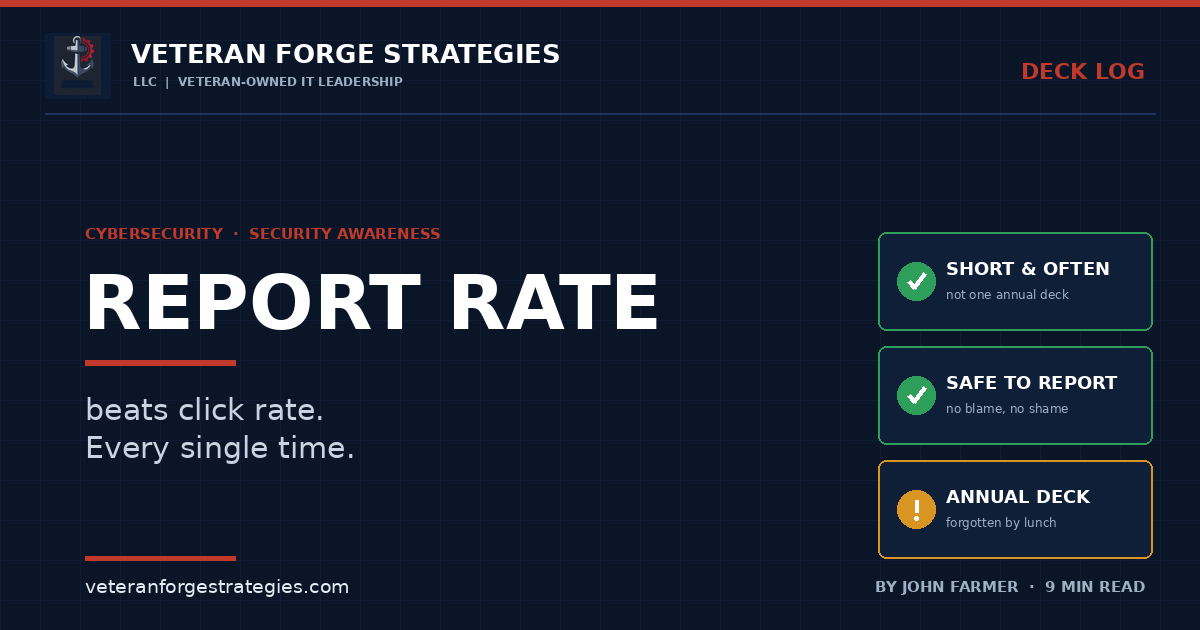
Most awareness programs measure the wrong thing. They obsess over click rate — what percentage of staff fell for the simulated phish. Click rate is easy to measure and emotionally satisfying, and it is only half the picture. The number I care about far more is report rate: of the people who saw something suspicious, how many told you about it, and how fast?
A team with a 10% click rate and a 2% report rate is a liability — people are getting fooled and nobody’s talking. A team with a slightly higher click rate but a 60% report rate is in dramatically better shape, because you will hear about the real attack while you can still do something about it. Chase report rate. It measures the behavior that actually saves you, and it rewards exactly the culture you are trying to build. A high report rate is also what makes your first hour of incident response possible — you cannot respond to what no one told you about.
Doing this on a small-business budget
None of this requires an enterprise security team or a six-figure platform. A workable program for a small organization looks like this:
- Onboarding: every new hire gets a short, human conversation about the handful of scams that actually target your business, and a clear, repeated message that reporting a mistake is always the right move.
- Ongoing: a brief, relevant touch every month or two — a two-minute note about a real threat making the rounds, not an annual marathon.
- Simulations: occasional, coaching-oriented phishing tests where clicking leads to a quick private lesson, never a punishment.
- One obvious button or address to report anything suspicious, and a visible, grateful response every time someone uses it.
That is it. The cost is mostly attention and consistency, which is exactly why it is the control most businesses skip — it isn’t a product you can buy and forget, it’s a habit you have to maintain. It pairs with the other human-layer controls: strong identity and access management so a single compromised login can’t reach everything, and the newer reality that attackers now use AI to make their lures far more convincing, which raises the premium on out-of-band verification over “it looked legitimate.”
Teach the tells, not the theory
When you do train, skip the vocabulary lesson and teach people the handful of concrete signals that catch the vast majority of real attacks. You are not trying to make them experts. You are trying to install a short mental checklist that fires before they click.
- The name doesn’t match the address. The display name says “Accounts Payable” but the actual email address is a string of gibberish at a domain you’ve never seen. Teach people to look at the real address, not the friendly name.
- It manufactures urgency. “Act now,” “your account will be suspended,” “the wire has to go out today.” Pressure is the oldest trick there is, because rushing is how people skip the checklist. Urgency is a reason to slow down, not speed up.
- The link doesn’t go where it says. Hovering over a link shows the real destination. If the text says one thing and the preview shows another, that’s the whole game right there.
- It asks to change where money goes. Any message that wants to update bank details, redirect a payment, or buy gift cards gets verified through a second channel — a phone call to a known number — before anyone acts. No exceptions, no matter how senior the sender appears.
- Something is just slightly off. The greeting is generic, the tone is wrong, the request is unusual for that person. Teach people to trust that instinct and ask, rather than talk themselves out of it.
Five signals, a few minutes to teach, and refreshed with a real example now and then. That is more protection than any annual deck has ever delivered. It is also the same instinct that defends against the fake-invoice and payment-redirect scams that quietly cost small businesses more than ransomware ever will.
The federal and contractor angle
If you handle federal data, awareness training is not optional — it is a named requirement. NIST SP 800-171 includes an entire Awareness and Training family (the 3.2 controls), which requires that managers and users are made aware of the security risks of their activities and that personnel are adequately trained for their roles, including insider-threat awareness. CMMC assessments expect to see it. But treat it as more than an audit checkbox. A contractor who can show not just a training record but a genuine reporting culture — evidence that people actually surface problems quickly — is demonstrating the kind of operational maturity a federal customer is really buying. The checkbox proves you ran the training. The report rate proves it worked.
Where this usually goes wrong
- Training is annual and generic. One long deck a year against a threat that changes monthly — forgotten before it’s finished.
- Phishing tests punish instead of teach. Shame the clickers and you train the whole organization to stop reporting.
- Only click rate is measured. The number that predicts whether you’ll survive a real attack — report rate — goes untracked.
- Reporting is hard or scary. No easy button, no grateful response, so people stay silent and you learn about the breach from someone else.
- It’s run as compliance, not culture. The certificate prints, the behavior never changes, and everyone mistakes the paperwork for protection.
Bottom line
Security awareness is the cheapest, highest-return control most organizations have, and the one they treat with the least care. You will never buy your way out of the human element — but you can turn it from your biggest liability into your best sensor network, if you train short and often, kill the blame, make reporting effortless, and measure the behavior that actually matters. Your tools protect the perimeter. Your people protect everything the tools miss. Small business or federal, your strongest firewall has a pulse.
Veteran Forge Strategies is an SBA-Certified Service-Disabled Veteran-Owned Small Business providing IT infrastructure, operations, and cybersecurity support to small businesses and federal clients from Northern Virginia. If your security training is an annual checkbox nobody remembers and you’d rather build a team that actually reports, that is exactly the engagement — get in touch. You can also read about how a fractional IT engagement works, the path from SAM.gov to a first subcontract, or browse the rest of the Deck Log.