The Best Datacenter Move Is the One Nobody Noticed
Twenty-plus years of zero-downtime cutovers under SOX, publicly-traded pressure, and the quiet discipline that separates a successful migration from a career-defining incident.
Monday morning at IPIX
In 2005, I was Director of Information Technology at IPIX Corporation, a publicly-traded software company headquartered in Reston, Virginia. That year, we relocated the entire corporate datacenter — every server, every switch, every storage array, every dependency the business ran on — to a new facility.
The following Monday, roughly two hundred employees logged into their workstations at the usual time. Their mail worked. Their file shares worked. The line-of-business systems responded the way they always did. Nobody noticed anything had happened.
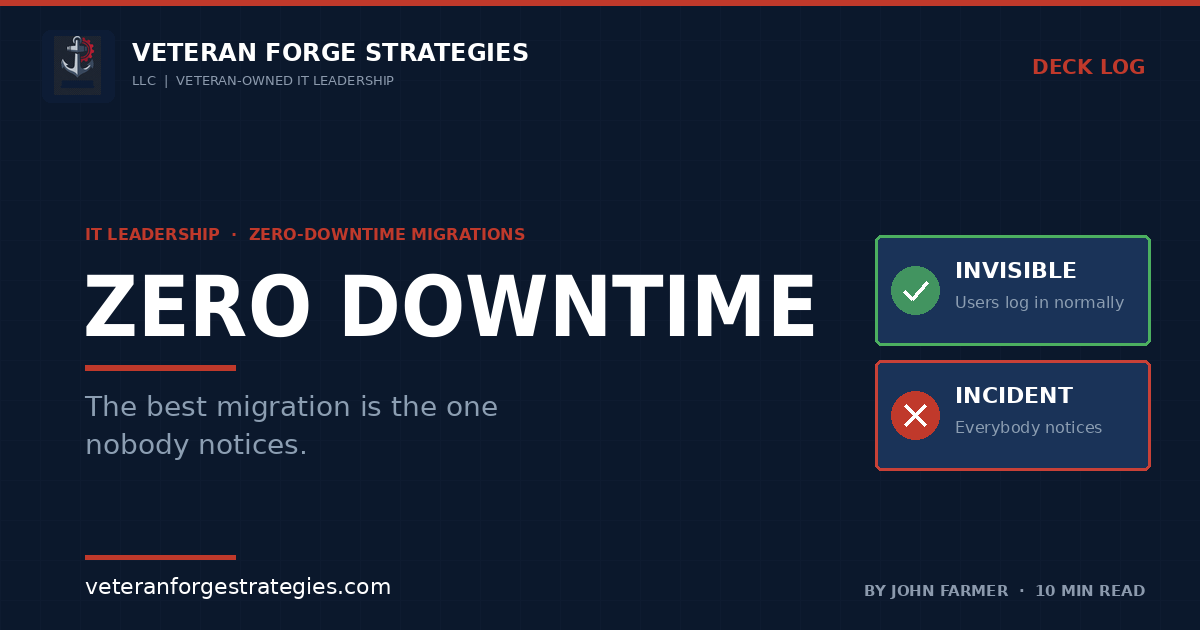
I have never received a compliment for that move. Nobody sends thank-you notes for a Monday that felt like every other Monday. And that, I’ve come to believe, is exactly the point.
In IT, invisible is the highest compliment. If your users didn’t feel the migration, you did it right.
But “invisible” is not a happy accident. It is the byproduct of a specific discipline — one I have practiced, refined, and repeated across four organizations and more than two decades. This article is what I would tell any IT leader, small-business owner, or federal program manager who is about to take on a datacenter relocation, a cloud migration, an ERP cutover, or any other move where an outage would cost real money and real trust.
The stakes have gotten higher. The playbook has not really changed.
The pattern behind the story
The IPIX move is the story I tell most often, because a publicly-traded company was the venue and Sarbanes-Oxley was the frame. But it is not the only time I have done this work. It is not even close.
- Xybernaut Corporation (1998–2005), Fairfax, VA. IT manager for a publicly-traded company with international offices in Germany, Japan, China, and Korea. First direct exposure to SOX and to the reality that no cutover happens in isolation when four time zones are counting on you.
- IPIX Corp (2005–2006), Reston, VA. Director of IT for a publicly-traded software company. Full datacenter relocation with zero downtime while achieving SOX compliance — building the control environment and running the physical move in overlapping cycles.
- Plateau Systems (2006–2008), Arlington, VA. Director of IT Services for a nationwide software firm. Office and datacenter relocation, large-scale VMware environments on SAN/EMC infrastructure, and the same zero-downtime discipline applied to a fully virtualized world.
- Capitol Exhibit Services (2010–present), Manassas, VA. IT Manager and sole IT leader for sixteen years. 99.9% network uptime across a full generation of infrastructure modernization: Exchange to Microsoft 365, SonicWall to pfSense, physical to virtual, Classic ASP to C# / .NET 8 / Blazor. Same discipline, applied continuously rather than as one-time events.
Four employers. Two publicly-traded. One Sarbanes-Oxley engagement. Multiple datacenter and infrastructure moves. One pattern.
The pattern is what this article is about.
Why “invisible” is the standard
In a regulated environment, the migration is the audit event. Auditors do not evaluate you on how smart you are. They evaluate you on whether the change was authorized, tested, reversible, communicated, and documented — and whether the evidence exists to prove all five.
The first time I lived through Sarbanes-Oxley, at Xybernaut, I thought the framework was overhead. By the time I ran a datacenter move under SOX at IPIX the following year, I understood the truth: the SOX control set is not opposed to zero downtime. It is the mechanism that produces it.
The controls force you to answer the questions you would have to answer anyway:
- Who authorized this change?
- What exactly is being changed?
- Who tested it, and against what?
- What is the rollback if it fails?
- Who was notified, and when?
- Where is the evidence?
If you can answer those six questions before you touch a rack, you have already done ninety percent of the work of a successful cutover. The other ten percent is executing carefully, keeping your head, and being honest when something surprises you.
The reader working in a small business without a formal control framework should not dismiss this section. You do not need to be publicly traded to benefit from the SOX mindset. You just need to want your Monday morning to feel like every other Monday.
The zero-downtime playbook
There are five disciplines that, taken together, produce a Monday nobody notices. I have never seen a successful zero-downtime migration that skipped any of them.
1. Dependency mapping — the work everybody underestimates
Before you sequence anything, you have to know what talks to what. Not what the documentation says, and certainly not what the previous IT lead told you three years ago. What is actually happening on the wire, right now, today.
At IPIX, dependency mapping took longer than the physical move. I walked every rack, ran every service, and cross-referenced against port scans and firewall logs to catch the systems that “nobody uses anymore” but that turned out to be critical to a quarter-close report that ran on the second Tuesday of every month. Those are the systems that kill migrations — the ones that are invisible until the moment they are missing.
For a modern environment the tools are better and the principle is the same. Whatever you use — a CMDB, a dependency scanner, a spreadsheet, a whiteboard, all of the above — the deliverable is a map that answers three questions for every system: what depends on it, what does it depend on, and what happens if it goes offline for thirty seconds.
If you cannot answer those three questions for a system, you are not ready to move it.
2. Cutover sequencing — the order that makes the map real
Once you have the map, you have to translate it into an order. What moves first, what moves last, and what has to happen simultaneously.
The temptation is to move the easy things first. Resist it. Move the things whose failure you can most easily recover from first. Get the operational muscle-memory in place on low-stakes systems, then work up the criticality curve. Your team will be sharper by the time it matters.
Sequencing is where a good runbook earns its keep. At Plateau Systems, the datacenter runbook for our move was a bound document — cutover step, expected duration, owner, verification step, rollback trigger, next-step-if-green, next-step-if-red. Every step. Nobody had to remember anything under pressure, because nothing was left to memory.
That runbook is also, incidentally, the audit evidence.
3. Rollback design — the plan you hope you never use
I have never executed a full rollback on a major cutover. I have designed one every single time.
The rollback plan is the reason the cutover works. Not because you expect to use it, but because designing it forces you to prove the cutover is reversible. If you cannot describe, step-by-step, how you get back to the previous state within your recovery time objective, then what you have is not a migration plan. It is a hope.
The test I use: if the network link to the new site fails at minute forty of a sixty-minute cutover window, can I be back on the old environment before end-of-day? If the answer is no, or “probably,” the plan is not ready. It needs another pass.
4. Testing discipline — until you are sick of it
Every environment I have moved has been tested end-to-end at least three times before the real cutover, and usually more. Not spot checks. Full runs: bring the new environment up, prove the workloads run, prove the integrations answer, prove the users can log in from the segments they log in from, prove the backup job completes to the new target.
At IPIX we ran the last full rehearsal exactly seven days before the real move, using production data on a Saturday, and rolled back on Sunday. The team was tired by the end of it. That was the point. If the team is tired after the rehearsal, they will be calm during the event, because the event will feel familiar.
If you are moving to a cloud environment, testing gets easier and harder. Easier because you can spin up parallel environments cheaply. Harder because the temptation to skip a rehearsal — “it’s the cloud, it just works” — is real, and misplaced. The cloud is a different set of failure modes, not the absence of them.
5. Stakeholder communication — no surprises, ever
The people who use the systems have to know what is happening, when, and what “success” looks like from their seat. The people who authorized the change have to know when it starts, when it ends, and what the current status is.
Nobody gets to be surprised.
At every organization I have worked in, the communication plan for a migration is drafted before the technical plan is finalized. Executive brief, user notice, help-desk briefing, post-migration confirmation. Timed, owned, and delivered on schedule. If the CEO learns about your cutover from a user complaint, the cutover has already failed, no matter what the technology did.
Modern equivalents — the racks got smaller, the discipline didn’t
I lifted physical servers in 2005. The last several years of migrations have not required any lifting at all. What has changed is only the medium.
- Cloud migrations. Moving mail from on-premises Exchange to Microsoft 365 is a migration. Moving file shares to OneDrive and SharePoint Online is a migration. Moving a database workload from on-prem SQL Server to Azure SQL or AWS RDS is a migration. Every one of them benefits from the same discipline that moved physical servers between buildings.
- Hybrid environments. Most organizations I see are not “on-prem” or “cloud.” They are both, connected by identity federation, VPN, and a set of assumptions about which system authoritatively owns which piece of data. Cutting one leg over — for example, replacing on-prem Active Directory dependencies with Entra ID as the primary identity source — is a cutover, and it deserves a runbook.
- System replacements. When I moved the perimeter firewall at Capitol Exhibit Services from a licensed SonicWall appliance to a pfSense platform, that was a datacenter move at the perimeter — every VPN client, every port-forward, every VLAN, every remote-access rule. Zero downtime, planned the same way as any other cutover.
- Application modernization. I am currently rebuilding an internal line-of-business application from Classic ASP to C# / .NET 8 with a Blazor front end. That is a migration, and it will cut over the same way — parallel-run, tested to exhaustion, rollback designed, communicated. The fact that the “datacenter” is a source-control repository does not change the playbook.
- Phone systems. I have replaced Cisco Call Manager and Asterisk PBX systems with modern VoIP platforms. Losing dial tone during business hours is exactly as unacceptable as losing email. Same discipline.
The unifying idea: any change where an unplanned outage would embarrass you deserves a zero-downtime migration plan. Whether you achieve zero-downtime is a separate question. Planning for it is table stakes.
What most migrations get wrong
The failure modes are as consistent as the successes. If you are watching a migration go sideways, you are almost always watching one of these five things happen.
- Underestimating dependencies. The single most common cause of a bad cutover is a system nobody remembered was important. The person who set it up left three years ago. It has no documentation. It talks to a vendor over an obscure port. The map missed it. If your dependency-mapping phase felt short, it was.
- No real rollback plan. “We’ll roll back if we have to” is not a plan. A plan has steps, owners, a clock, and a decision point. If the go/no-go call at minute thirty is not defined, you will make it under stress with incomplete information, which is exactly the wrong condition for that decision.
- Treating the maintenance window as the plan. “We have a four-hour window on Saturday night” is a constraint, not a strategy. If your only defense against a bad cutover is a hope that the window is long enough, the plan is not finished.
- Communicating too late. The user notice that goes out at 4:47 PM on Friday for a Saturday-night migration is not communication. It is legal cover. Real communication starts days ahead, is repeated, is targeted (finance cares about different systems than the shop floor), and includes what the user should do if something looks wrong on Monday.
- Testing in production. If the first time the new environment sees real load is Monday morning, you are not migrating. You are gambling. It might work. It often does. But you have replaced engineering with luck, and luck is not a strategy you can put in a capability statement.
Every one of these failures is preventable, and every one is culturally rather than technically driven. The technology almost always works. It is the discipline around the technology that decides whether Monday morning feels like every other Monday.
Why federal buyers should care
If you are a program manager, a contracting officer, or a federal IT leader evaluating a small-business contractor for infrastructure or modernization work, this is the discipline you should be probing for. Not the certifications on the wall. Not the sales-deck logos. The actual, documented practice.
The zero-downtime playbook maps almost one-for-one to federal expectations that already exist:
- Change management under NIST SP 800-53 (CM family — Configuration Management) — authorization, testing, and documentation of every configuration change. Same six questions the SOX auditors ask.
- Continuity of Operations (COOP) — the requirement that essential functions continue during and after a disruption. A zero-downtime cutover is COOP applied to a planned change.
- CMMC and NIST SP 800-171 for defense contractors — change-management, audit, and incident-response controls that assume you can produce evidence of what was changed, when, by whom, and with what authorization.
- FISMA reporting — the assumption that federal information systems are managed with documented, repeatable processes. Your migration runbook is that documentation, in one place, ready to hand to an assessor.
The same discipline that produces a quiet Monday morning also produces a clean audit finding. That is not a coincidence. It is the reason SOX exists, and the reason FISMA exists, and the reason CMMC exists. The frameworks vary. The underlying question does not: can you prove you are in control of your environment?
The contractors and government IT teams I would trust with a critical migration are the ones who can answer yes to that question — not by pointing at a policy document, but by walking me through the runbook from the last time they did it.
The Navy taught me one more thing
I spent my Navy years as an Aviation Structure Mechanic in San Diego. The rate exists because a helicopter or an aircraft is a system in which no single component can fail quietly. Everything is inspected, everything is documented, everything is signed for, and every corrective action has a paper trail that survives the person who performed it.
Nothing on an aircraft is invisible. That is what makes the aircraft safe.
IT infrastructure is not a helicopter. But the discipline is more transferable than it looks. The reason we document, test, communicate, and design for rollback is not because the auditor requires it. It is because the alternative — trusting memory, hope, and the goodwill of Monday morning — is not a system you can defend when it eventually fails.
A zero-downtime migration is not a heroic act. It is a boring one. It is the accumulation of hundreds of small, disciplined decisions made in advance, so that no heroic decisions have to be made under pressure. The best migrations I have led did not feel dramatic while they were happening. They felt like reading the runbook aloud.
If that sounds like something your next migration needs, we should talk.
Veteran Forge Strategies is a Virginia-based Veteran-Owned Small Business providing IT leadership, infrastructure modernization, and zero-downtime cutover planning for federal agencies, prime contractors, and small businesses. Learn more about our capabilities or get in touch.